Galaxy Z Fold7 Verdict: The Book-Style Foldable That Finally Slims Down
At 4.2mm open and 215g, Samsung's 2025 Fold pairs an 8-inch inner screen and a 200MP main camera with a much less awkward cover display.
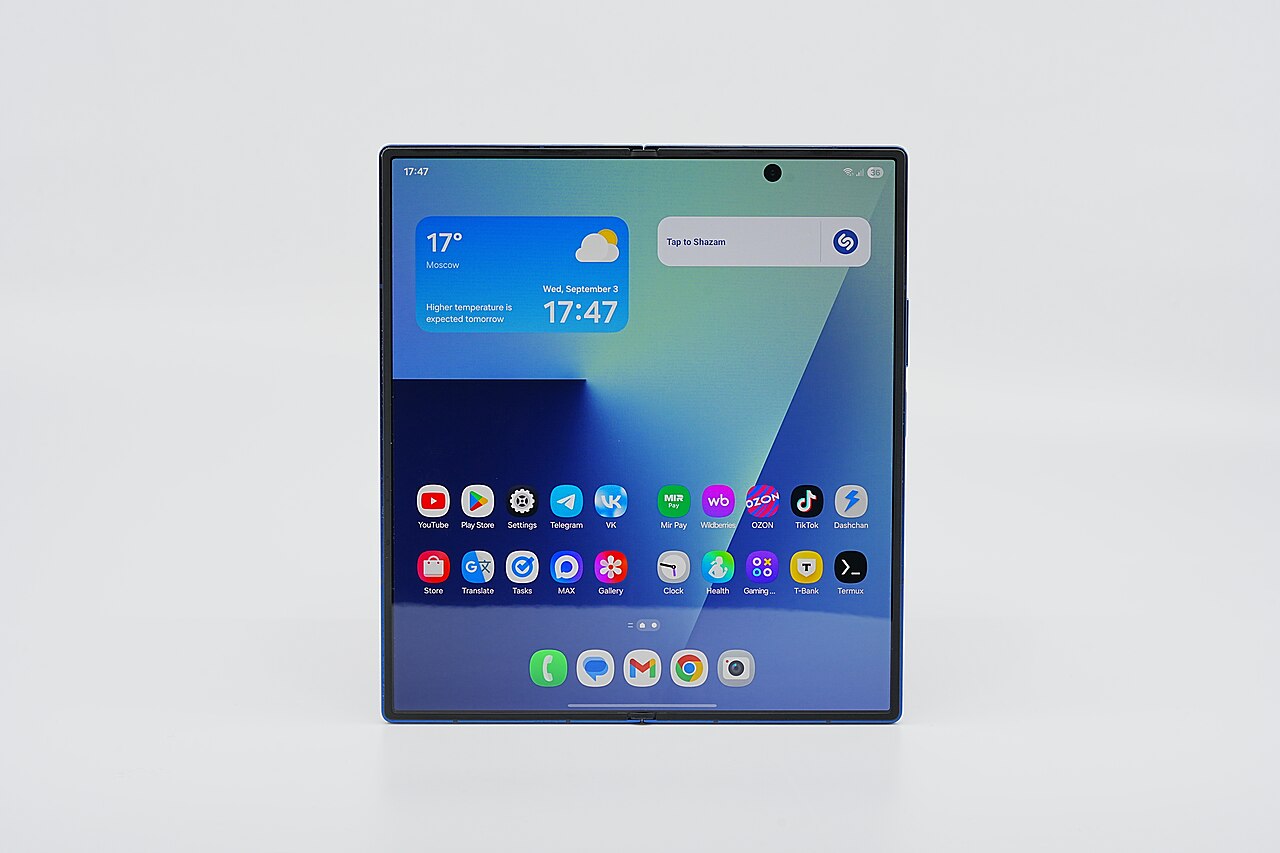
Foldable phones have always asked their owners to accept a compromise: you get a bigger screen, but you carry more weight, more thickness and more risk. The Galaxy Z Fold7, announced on July 9, 2025 and released on July 25, is Samsung's most serious attempt yet at shrinking that compromise. It is the lightest and thinnest book-style Galaxy Z Fold to date, it swaps in a wider outer screen, and it borrows the 200MP main camera from the flagship slab range. This verdict works through the specification to judge how much of the compromise has really gone away.
Thinner, lighter, easier to carry
The first thing to understand is the size. Folded, the Galaxy Z Fold7 measures about 158.4mm tall, 72.8mm wide and 8.9mm thick. Unfolded, it is 143.2mm wide and just 4.2mm thick, and it weighs 215g. Those are the figures that matter for the daily experience of a foldable, because thickness and weight are what make earlier books feel like a brick in a jacket pocket. For context, a slab such as the Galaxy S25 is only about 7.2mm thick, and while a folded phone can never match a slab for thickness, this design brings the gap down to something reasonable. Samsung credits refinements to the hinge and frame for the change, and it keeps the book-style folding format that defines the series.
If you have used an older Fold and found it tiring to hold, the difference in weight is likely to be the reason to consider an upgrade. If you are new to foldables, it is the model that asks the least of you in terms of adaptation.
Two screens, each with a clear job
The inner screen is an 8.0-inch foldable Dynamic LTPO AMOLED 2X panel with a resolution of 1968 x 2184 pixels, about 368 pixels per inch, a 1 to 120Hz adaptive refresh rate, HDR10+ and a peak brightness of 2600 nits. Its aspect ratio is close to square at 1.11:1, which makes it good for reading, documents, spreadsheets, side-by-side apps and watching video in a large window. The main display is covered with Ultra Thin Glass, and the phone has a hole-punch camera in the inner screen for video calls.
The cover display is the more important upgrade in daily use. It is a 6.5-inch panel with a 21:9 aspect ratio and a resolution of 1080 x 2520 at 422 pixels per inch, and it is protected by Gorilla Glass Ceramic 2. Earlier Folds had a narrow outer screen that made typing awkward. A wider 6.5-inch face makes it feel like a normal phone when closed, so you can do quick tasks without opening the phone. That makes the device more flexible: it is a phone when you want one and a small tablet when you want that instead. For a broader look at the folding format, see our foldables coverage.
Software adds to the value of the shape. Flex Mode lets an app use the upper half of the screen for content and the lower half for controls when the phone is partly folded, typically between about 75 and 115 degrees. Video and note-taking apps can use this to turn the phone into a small laptop-style device on a table.
Performance
The Fold7 runs the Snapdragon 8 Elite, built on 3nm, with two Oryon cores at up to 4.47GHz and six at 3.53GHz and an Adreno 830 graphics processor. Memory is 12GB of LPDDR5X on standard versions, with 16GB on the 1TB model, and storage options are 256GB, 512GB and 1TB using UFS 4.0. That is a close relative of the chip in the Galaxy S25 range, so you are not sacrificing raw speed to get a folding body. For a device whose selling point is multitasking with several windows open, the generous memory matters as much as the chip. Connectivity includes Wi-Fi 7, Bluetooth 5.4 and USB-C 3.2, plus dual nano-SIM and eSIM support depending on region.
Cameras: a big step for a foldable
Foldables have often shipped with weaker cameras than slab flagships because of the space constraints of a thin body. The Fold7 tackles that with a 200MP main camera using an f/1.7 lens, a 1/1.3-inch sensor and optical stabilisation. Alongside it sit a 12MP ultrawide with a 120 degree view and a 10MP telephoto with 3x optical zoom and stabilisation. There are two front cameras, one 10MP unit on the cover screen and one 10MP unit inside. Video recording reaches 8K at 30fps and 4K at 60fps, and Log recording is supported on all cameras.
The main sensor is the star here. A large 200MP main sensor gives you room to crop and to choose between detail and low-light performance depending on how the phone bins pixels. The ultrawide and telephoto are more conventional. The 12MP ultrawide is ordinary for a flagship, and the 3x telephoto is only 10MP, so people who care most about zoom will find better lenses on some other phones, including the 5x periscope on the Pixel 8 Pro. Still, having a strong main camera and a usable telephoto in a foldable is a clear advance over the older ones. A practical bonus of the foldable body is that you can use the large inner screen as a viewfinder and prop the phone in Flex Mode for hands-free shooting.
Battery, charging and durability
The battery is a dual-cell design rated at 4400mAh, and the regulatory filing lists a typical capacity of 4272mAh. That is smaller than the 5000mAh cells in slab flagships, but a foldable has to divide its battery between two halves and keep the body thin, so it is not a surprising figure. Charging is 25W wired, which Samsung says gives 50 percent in about 30 minutes, plus 15W wireless and 4.5W reverse wireless. For reference, our Xiaomi 14 page lists 90W wired charging, so 25W is clearly at the modest end. Given the large screen area, heavy users should expect to top up during the day, and we would not judge the phone as a marathon endurance device from the specification alone.
Durability is the most important limit to understand. The water and dust rating is IP48. The 4 means protection against solid objects larger than 1mm, so it does not have the fine-dust protection of an IP6x rating, and the 8 means it can be immersed in water up to 1.5 metres for 30 minutes. Fine dust and sand are therefore the enemy of the hinge and inner screen, and anyone who takes their phone to the beach should be careful. As with all foldables, the flexible inner display is more vulnerable than the glass on a slab, so a screen protector and careful handling matter more here.
Software and long-term value
The Fold7 launched with Android 16 and One UI 8, and Samsung promises up to seven major Android upgrades, the same commitment it applies to the S series. Galaxy AI features such as Generative Edit, Circle to Search with an AI Mode and Gemini Live camera integration are included, and several of them are designed to make use of the large inner display. Seven years of support matters more for an expensive foldable than for a cheap phone, because it lets you keep the device for far longer before needing to replace it.
Who it suits
The Galaxy Z Fold7 is for people who want a phone and a small tablet in one device and are prepared to pay for it. If you spend a lot of time reading, working in documents or running two apps side by side, the inner screen is a real productivity tool, and the thin and light body makes carrying it easier than any previous Fold. If your priorities are the biggest battery, the fastest charging or the best zoom, a slab phone will suit you better. If you are attracted by the folding idea but prefer a clamshell that shrinks to pocket size, read our guide on whether a flip phone is worth it in 2026 and the Galaxy Z Flip5 verdict for the other side of the story.
We give the Fold7 an 8.4. The hardware sheet is excellent, the design improvements are real, and the wider cover screen fixes the most common complaint about older Folds. The points held back reflect the foldable format itself: the modest battery, the slow-ish charging and the IP48 durability rating. Prices differ by region and configuration, so check current offers before buying.
Pros
- 215g and 4.2mm unfolded make it the lightest and thinnest Fold so far
- Wider 6.5" 21:9 cover display works as a normal phone screen
- 8-inch 1968x2184 inner display with 120Hz LTPO and 2600-nit peak
- 200MP main camera, a big jump for a foldable
- Snapdragon 8 Elite with up to 16GB of RAM
- Seven years of OS and security updates promised
Cons
- IP48 protects against water splashes and larger dust, but not fine dust
- 25W wired charging is slow next to many slab phones
- 4400mAh battery is modest for such a large screen area
- Telephoto is a 10MP 3x unit and the ultrawide is 12MP
- A foldable crease and fragile inner screen remain inherent trade-offs