Galaxy S25 Ultra Verdict: A Four-Camera Titanium Flagship With an S Pen
Samsung's biggest 2025 flagship pairs a 6.9-inch QHD+ display with a 200MP main camera, two telephoto lenses and a seven-year update promise.
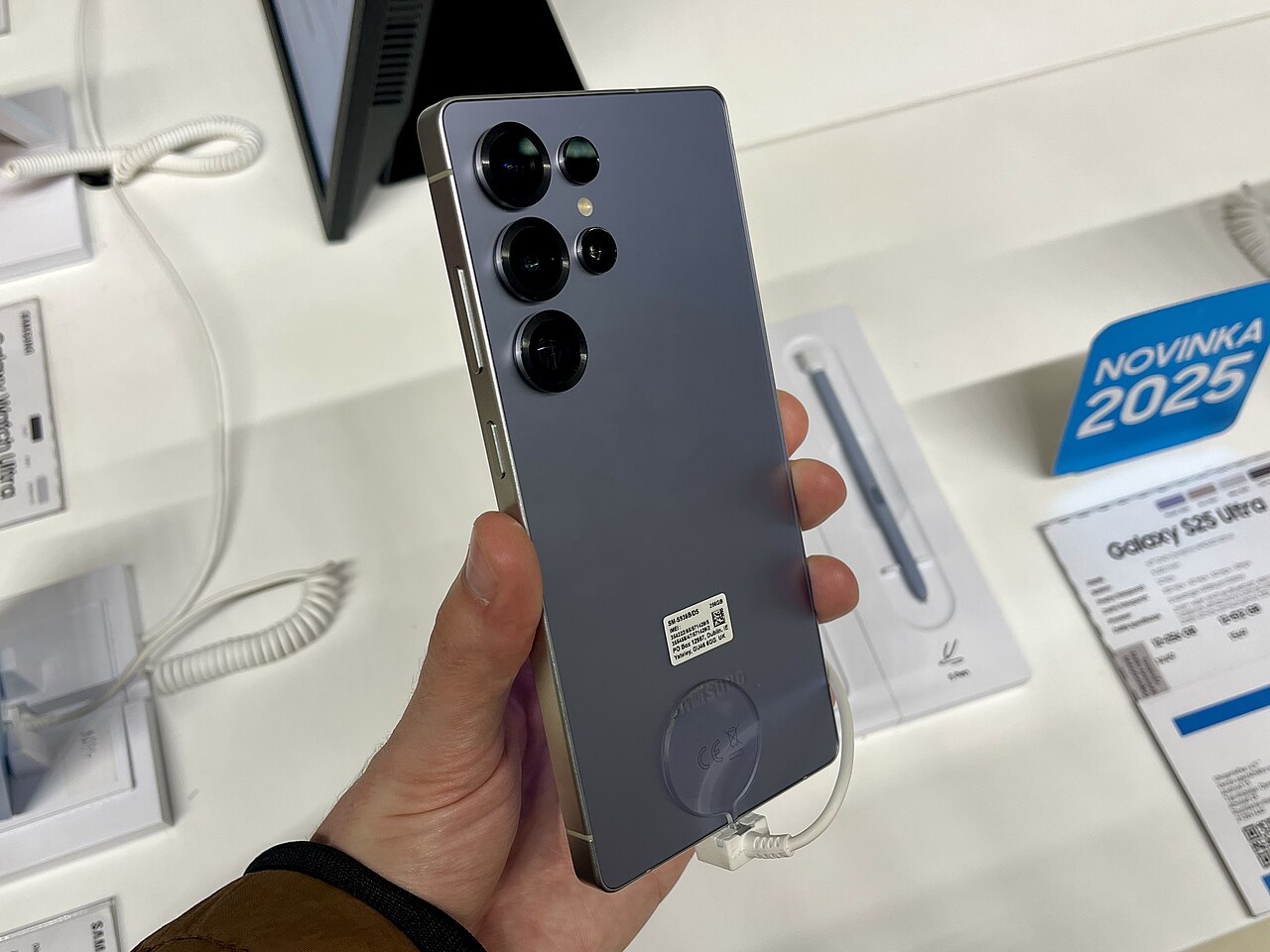
The Galaxy S25 Ultra is the phone Samsung builds when it wants to make no compromises on hardware. Announced on January 22, 2025 and released on February 7, it sits at the top of the S25 family and is the only model in the line that combines a 6.9-inch screen, a titanium frame, four rear cameras and an S Pen. This verdict reads the specification carefully and asks a simple question: which parts of that long list change what it is like to own the phone, and which are there mainly for the spec sheet?
Design: titanium, rounded corners and tougher glass
The S25 Ultra has a titanium frame and glass on both sides. Compared with the S24 Ultra, the corners are rounded instead of squared, which softens the phone in the hand and brings it closer to the look of the rest of the Galaxy S range. Samsung switched the front and back glass to Gorilla Armor 2, an anti-reflective glass-ceramic from Corning. The glass maker states the material is more than four times more scratch-resistant than conventional aluminosilicate cover glass, and reports that it survived drops from 2.2 metres onto a surface simulating concrete in its laboratory tests. Those are supplier claims rather than our results, but they show what the design is aiming at: fewer cracks and less glare outdoors.
The body measures 162.8 x 77.6 x 8.2mm and weighs 218g. That makes it the heaviest phone in the S25 range and a real handful, and it is one reason a smaller flagship like the Galaxy S25 remains attractive for people who want a compact device. The phone has an IP68 rating, so it is protected against dust and water immersion up to 1.5 metres for 30 minutes. Colours at launch included Titanium Silverblue, Black, Whitesilver and Gray, with extra shades sold in some channels.
A big QHD+ display
The screen is a 6.9-inch Dynamic LTPO AMOLED 2X with a 3120 x 1440 resolution, roughly 498 pixels per inch, a variable 120Hz refresh rate and HDR10+. Samsung lists a peak brightness of 2600 nits. The high pixel density means text is very crisp, and the LTPO technology lets the panel drop its refresh rate when nothing is moving to save power. There is also an ultrasonic under-display fingerprint sensor, a different technology from the optical sensors used on some rivals. Samsung includes an AI upscaler called ProScaler tuned for the QHD+ resolution, designed to make lower-resolution content look better on the sharp panel. Whether you notice that will depend on the content you watch, but it shows the screen and software are designed together.
Chip, memory and cooling
Every S25 Ultra runs the Snapdragon 8 Elite for Galaxy, a 3nm chip with two Oryon cores at up to 4.47GHz and six at 3.53GHz, plus an Adreno 830 GPU and a Snapdragon X80 modem. There is no regional chip split on this model, which is a relief for anyone who remembers the mixed Snapdragon and Exynos arrangement on earlier generations, as discussed in our Galaxy S24 verdict. Memory is 12GB across the line, with 16GB on certain 1TB models sold in South Korea, China, Hong Kong and Taiwan. Storage runs to 256GB, 512GB or 1TB using UFS 4.0.
Samsung also redesigned the cooling. The Ultra uses a vapor chamber about 40 percent larger than before, with extra material layers to spread heat. A large chamber does not raise peak speed on its own, but it can help the chip keep its clocks steadier in long sessions such as gaming and video export. The specification gives us the design intention; we have no measured thermals to add.
Four cameras, four zoom steps
The camera system is where the Ultra separates itself from the rest of the range. There is a 200MP main camera with an f/1.7 lens and a 1/1.3-inch sensor with optical stabilisation, a 50MP ultrawide at f/1.9 with a 120 degree view, a 10MP 3x telephoto at f/2.4, and a 50MP periscope telephoto at f/3.4 with 5x optical zoom, stabilised as well. The front camera is 12MP. Samsung describes the combination as a Quad Tele System, giving optical-quality zoom at 2x, 3x, 5x and 10x.
What does this mean in practice? Multiple telephoto steps let you frame a distant subject without relying purely on digital enlargement, which is useful for concerts, wildlife, sport and architecture. The 50MP ultrawide is a marked step up from the 12MP unit in the standard S25 and S25+, which helps with cropping wide scenes. The one weak spot on paper is the 3x telephoto, which is only 10MP, far below the other three cameras. If you shoot at that focal length often, the phone may rely more on its image processing there than at other zoom levels. For a look at how other brands handle telephoto hardware, the Pixel 8 Pro page lists its own 5x lens for reference. Samsung also pairs the cameras with its ProVisual Engine for scene analysis and noise reduction, and all four lenses support the Super Steady video mode.
Battery and charging
The battery is 5000mAh. Wired charging is 45W, and Samsung says it can reach about 65 percent in around 30 minutes with a 45W adapter. Wireless charging is Qi2 at up to 15W, and the phone can share its own battery wirelessly or by cable at 4.5W. These are respectable but not class-leading speeds. For reference, our Xiaomi 14 page lists 90W wired charging. The trade-off for Samsung is that the phone favours consistency and safety margins over headline wattage. Check our charging articles if you want to understand how much the speed actually matters to daily habits.
Software, AI and the S Pen
The phone launched with Android 15 and One UI 7, and Samsung promises seven years of operating system and security updates, a policy that runs to 2032 for this generation. That is among the longest support promises in the phone market and a strong reason to think of the S25 Ultra as a long-term purchase. The phone also carries the Galaxy AI features that Samsung has been building up, including Circle to Search and live translation.
The S Pen is still included and still lives in a slot in the body, which is a feature very few current phones offer. One important change is that it no longer has Bluetooth, so features that relied on it, like a remote camera shutter and air gestures, are gone. Samsung explained that the Bluetooth features were used by a very small share of users and that removing them lowered cost. If you use the pen mainly to write and draw, the change will not matter. If you depended on the remote shutter, it is a genuine loss.
The verdict
The Galaxy S25 Ultra earns the top score in our current range, 8.7, because almost every line in the specification is at or near the top of the market: the display, chip, cooling design, camera lineup, glass and update policy. The deductions are practical rather than technical. The phone is big and heavy, charging is only mid-pack for the price class, the 3x telephoto has a small sensor, and the S Pen has lost its Bluetooth tricks. For someone who wants one phone that does everything, including handwriting and long-range zoom, it is the strongest case Samsung makes. For someone who prefers a smaller phone, the standard S25 is a better fit. Explore more flagships in our verdict archive to compare the trade-offs.
Pros
- Four rear cameras with 2x, 3x, 5x and 10x optical zoom options
- 6.9" QHD+ LTPO AMOLED at 120Hz with a 2600-nit peak
- Snapdragon 8 Elite for Galaxy with a larger vapor chamber for cooling
- Seven years of OS and security updates promised
- Titanium frame and Gorilla Armor 2 glass front and back
- Built-in S Pen with the phone
Cons
- The S Pen no longer supports Bluetooth features such as remote shutter and air actions
- 45W wired charging is modest against the fastest rivals
- Large body at 218g and 77.6mm wide is hard to use one-handed
- 3x telephoto is only 10MP, far below the other three cameras
- Wi-Fi and cellular extras vary by region, including RAM on some 1TB models