Spec Scores vs Lab Tests: Rating a Mobile Phone on Paper
How a spec-based score rates a mobile phone, what it misses, and when to turn to full smartphone reviews or wait for hands-on verdicts today.
Every buyer eventually faces the same problem: hundreds of handsets, a few evenings of research, and one budget. A single number that sums up a phone looks tempting. But what does such a number actually tell you, and what does it hide? This piece looks at how a score built purely from specifications works, and where it stops being useful.
As a case study we will use the catalog scoring system from one of the more transparent sources of English smartphone reviews and spec data. It rates every mobile phone from published figures alone, with no lab bench involved. That makes it a clean example of what paper-based rating can do, and a useful contrast with hands-on testing.
What it means to rate a mobile phone on paper
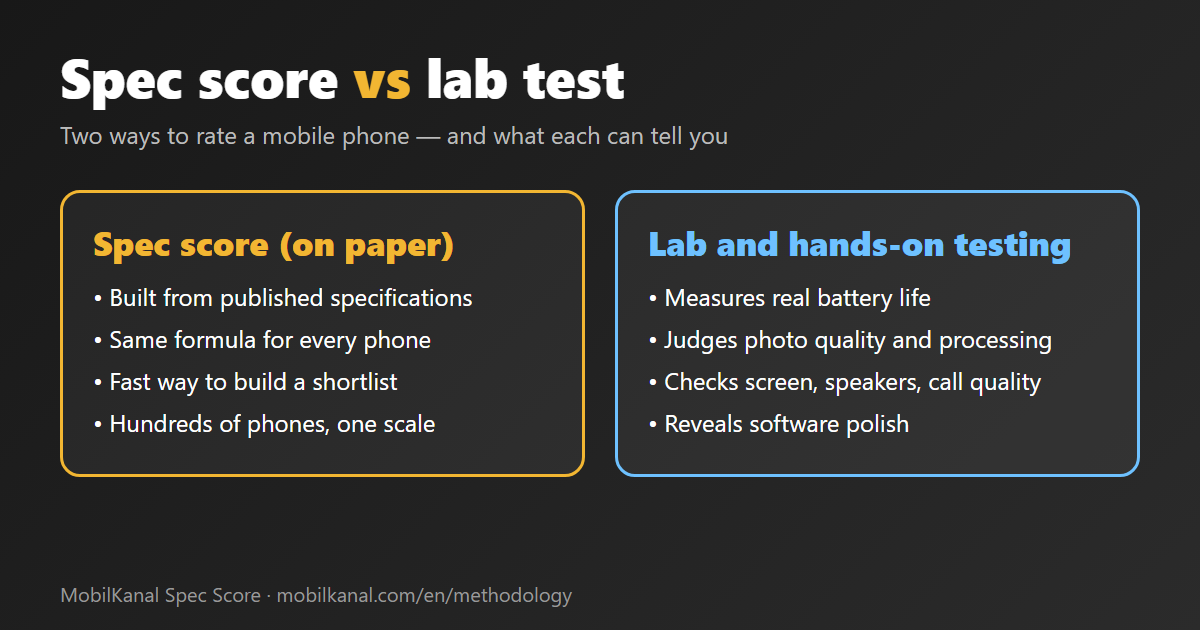
A paper rating takes numbers that a manufacturer publishes, such as chipset, display type, battery capacity and charging power, and converts them into a score. Nobody has to hold the device. The same formula is applied to every model, so the result is consistent from one phone to the next.
That consistency is the real strength. Two reviewers using a stopwatch and a camera may disagree about the same handset, but a formula never has a bad day. It will, however, never notice that a screen looks washed out or that an app crashes twice a day.
In short, a paper score answers one question well: how much hardware is on offer? It does not answer the question most buyers really care about, which is how will this feel after six months?
What smartphone reviews measure that a spec sheet cannot
Good smartphone reviews rely on things a spreadsheet cannot capture. A tester lives with the device, takes photos in poor light, runs a battery drain routine and watches how the software behaves after an update. Those observations are slower and more expensive to produce, which is why you find fewer of them.
Here is a quick comparison of what each approach contributes:
- Spec-derived scores: broad coverage, instant comparison, fully repeatable, easy to audit.
- Lab tests: measured brightness, colour accuracy, sustained performance, charging curves.
- Long-term use: software stability, real battery endurance, durability, how the camera copes with everyday scenes.
None of these replaces the others. A paper score is a map, a lab result is a measurement, and long-term use is the lived experience. Treating them as interchangeable is the most common mistake in phone shopping.
Inside the MobilKanal Spec Score: four weighted parts
The MobilKanal Spec Score is a number between 0 and 100, calculated by formula from published specifications. The site is explicit that it is not a test result. Four parts feed into it, each with its own weight.
Performance: 30 percent
This is the heaviest component. It looks at the generation tier of the chipset and adjusts for the amount of RAM. In plain terms, a newer processor tier with sensible memory scores higher than an older one with less.
Display: 25 percent
The display part rewards OLED or AMOLED panels, higher refresh rates (the tiers are 90, 120 and 144 Hz and above), higher resolution and higher peak brightness. It reads the panel specification, not the picture you will see.
Battery and charging: 25 percent
Capacity in mAh makes up roughly 65 percent of this part, while wired charging power in watts accounts for about 35 percent. A small bonus is added for wireless charging. Notice that this rewards a large battery and fast top-ups, but it cannot say how long the phone really lasts.
Camera hardware: 20 percent
The camera part checks main sensor resolution and size, optical image stabilisation, the presence of telephoto and ultra-wide lenses, and the top video mode. The site states plainly that photo quality itself is not measured. A large sensor on paper is a promise, not a result.
How the value score adds price to the picture
A high Spec Score alone says little if the phone costs a fortune. For that reason the catalog also computes a value score. For handsets with a current price in Turkey, the Spec Score is divided by a smoothed function of the price. The outcome is then converted into a percentile across all priced phones.
The percentile wording matters. A value score of 80 means the phone offers more specification per unit of price than roughly 80 percent of the priced phones. It does not mean "80 out of 100 quality".
There are two practical cautions. First, prices are shown in Turkish lira (TRY) and come from the Turkish market, and in some lists they are converted to dollars from Turkish market listings. Second, prices move. The site itself recommends confirming the latest price with the seller before you buy.
What a mobile phone spec score deliberately leaves out
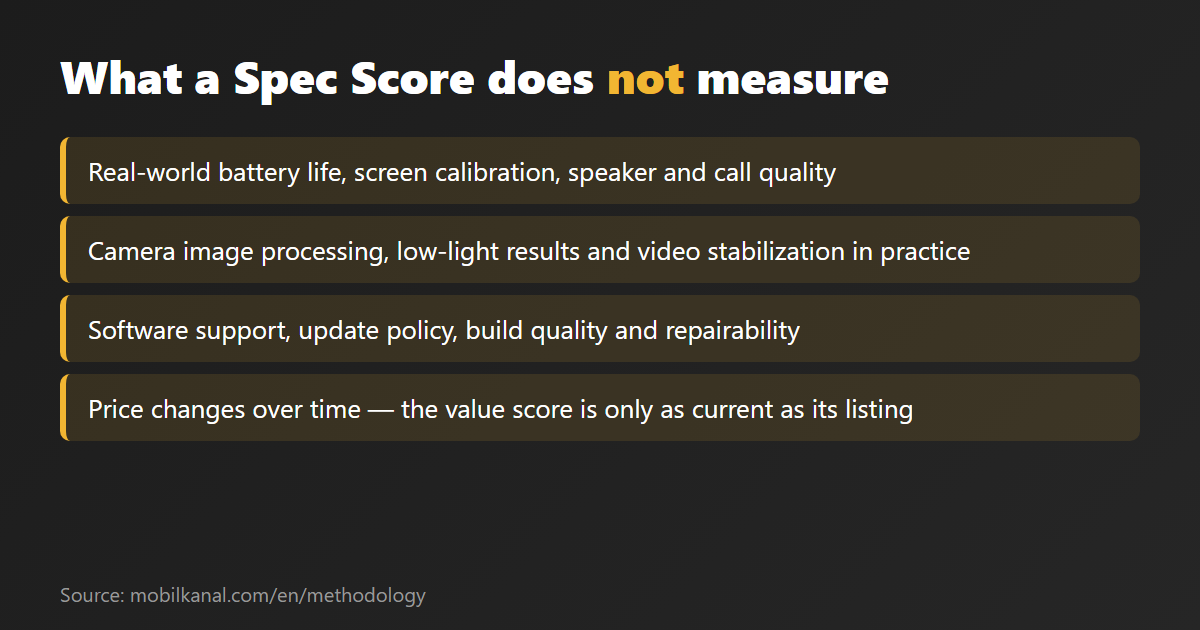
Honest scoring systems tell you what they skip. The MobilKanal methodology lists the gaps openly, and they are significant:
- real-world battery life and screen calibration;
- speaker and call quality;
- camera image processing, low-light results and practical video stabilisation;
- software support and update policy;
- build quality and repairability;
- how the price changes over time.
Look at that list again. Software support, repairability and real battery life are exactly the factors that decide whether a handset is still pleasant two years later. A paper score cannot see any of them, so it should never be your final word.
The stated purpose is modest and sensible: to rank hundreds of phones consistently by hardware and help you create a shortlist. When two scores are close, the guidance is to open the spec tables and the side-by-side pages instead of leaning on the gap.
How to build a mobile phone shortlist, step by step
A spec-derived score is at its best at the start of a search. Here is a simple routine that uses it for what it is good at:
- Set a ceiling. Decide the most you will pay, then remember that prices change.
- Pick one priority. Battery, display, camera hardware or raw speed. Choose one, not four.
- Open a matching Top list. The catalog ranks phones by a single measurable criterion, for example the biggest batteries, the fastest charging or the strongest camera hardware.
- Note five or six names. Ignore tiny score gaps and keep a variety of brands.
- Check the value view. Lists such as best value by specs per price help when money is tight.
The catalog covers 931 phone models from 119 brands, so the pool is large. The biggest brand pages are Samsung with 114 models, Apple with 81 and Xiaomi with 67, followed by Oppo, vivo, Honor, OnePlus, Huawei, Realme, Google, Poco and Asus. If you prefer to browse our own listings first, our phone database offers the same style of filtering by brand.
How to read a spec sheet and use the compare page
Once you have a shortlist, the sheet for each model becomes the working document. It lists the display, chipset, memory and storage, cameras, battery, connectivity (5G, Wi-Fi, Bluetooth, NFC), size and weight, operating system and release date. Unknown values are left blank rather than guessed, which is a good habit worth copying.
Reading the sheet in four passes
- Pass one: check the release date and the operating system. An older release usually means a shorter remaining update window.
- Pass two: compare the chipset and memory against what you will actually do with the phone.
- Pass three: look at battery capacity next to charging power, then at weight, since big cells add grams.
- Pass four: confirm the connectivity you need, such as NFC for payments.
Using the compare page
The compare tool places two or three phones side by side, covering display, chipset, camera, battery and price. Add your shortlist, then read across each row rather than down each column. Differences that matter to your priority will stand out quickly.
Each phone page also carries a short editorial note, written from the listed specifications, which explains what the numbers mean in daily use. Treat it as a translation of the sheet, not as a test report.
When to trust a score, when to read full smartphone reviews
Now for the decision framework. Whichever mobile phone you are considering, the right source depends on the question you are asking and on how much a mistake would cost you.
Trust the score when
- you are narrowing hundreds of models down to a handful;
- your priorities are hardware you can count, such as battery size or charging watts;
- you want a transparent, repeatable ranking, not an opinion.
Read full smartphone reviews when
- two candidates score within a few points of each other;
- camera quality, screen quality or call quality is your main reason to upgrade;
- you are spending a large amount and want a human view on the experience.
You can read our full verdicts for this second path, since they are written to answer the questions a formula cannot reach.
Wait for hands-on verdicts when
- the phone has only just been announced and nobody has used it for long;
- the model depends on a new chipset or new software that has not matured;
- software updates and long-term reliability are central to your decision.
Waiting to buy a new mobile phone costs little. Prices often settle after launch, and early firmware problems tend to surface within weeks.
Making use of reviews, news and the glossary around a mobile phone
The English section of the catalog also contains hundreds of review pages, news articles and comparison pages. Its reviews are organised under design, display, performance, camera and battery headings. Importantly, they are based on published specifications and are not laboratory tests, so read them as structured explanations rather than measurements.
The news section covers launches, leaks and industry developments, giving the device specifications and background with each story. For the same kind of coverage from this site, see our latest phone news, which is handy when a rumour makes you wonder whether to wait.
Then there is the glossary, with more than 300 terms from 2G to Zigbee, including AMOLED and Wi-Fi. If a spec line looks like alphabet soup, a plain-English definition is a few clicks away. That alone makes paper research less intimidating for first-time buyers.
One honest note: a forum is listed as "coming soon", so it is not available yet. Questions about how prices are kept current, how to compare, or how to request a model that is missing are answered in the site's FAQ.
Frequently asked questions
Is a spec score the same as a lab test?
No. A spec score is calculated from published figures and involves no measurement. It cannot reflect image quality, software polish or real battery endurance, which is why it works best as a shortlist tool.
How many phones does the catalog cover?
At the time of writing it lists 931 models across 119 brands, with Samsung, Apple and Xiaomi having the most entries.
Can I compare more than two phones at once?
Yes. The compare page accepts up to three phones and lines them up on display, chipset, camera, battery and price.
Are the prices up to date?
Prices are in Turkish lira from the Turkish market where one exists, and some lists convert them to dollars. Because prices change, confirm the final figure with the seller.
Should I buy a mobile phone on score alone?
It is better not to. Smartphone reviews and hands-on feedback exist for a reason. Use the score to find candidates, then read detailed smartphone reviews and wait for hands-on feedback if the phone is brand new.
Conclusion
A specification score is a fast, fair and repeatable way to sort a very large field, and the MobilKanal approach is a good example because it states its weights and its blind spots. Its four parts, performance at 30 percent, display and battery at 25 percent each and camera hardware at 20 percent, make the logic easy to inspect.
Use such a number to build a shortlist, use the compare page and spec tables to separate close candidates, and use detailed smartphone reviews and hands-on verdicts before you commit. Used in that order, paper ratings save time without costing you accuracy when you choose your next mobile phone.